
You suddenly hit non-deterministic tool failures, state loss mid-execution, unconstrained token budgets, and impossible-to-debug multi-agent loops. In 2026, agentic AI development is no longer about writing clever system prompts; it is an infrastructure challenge. Choosing the wrong framework forces your engineering team to spend months building custom state persistence, retry handlers, and tracing layers from scratch.
This breakdown evaluates the three leading orchestration engines—LangGraph, CrewAI, and Mastra—so you can select the exact framework your stack requires.
The 2026 Framework Trilemma
The agent orchestration ecosystem has split into three distinct architectural models:
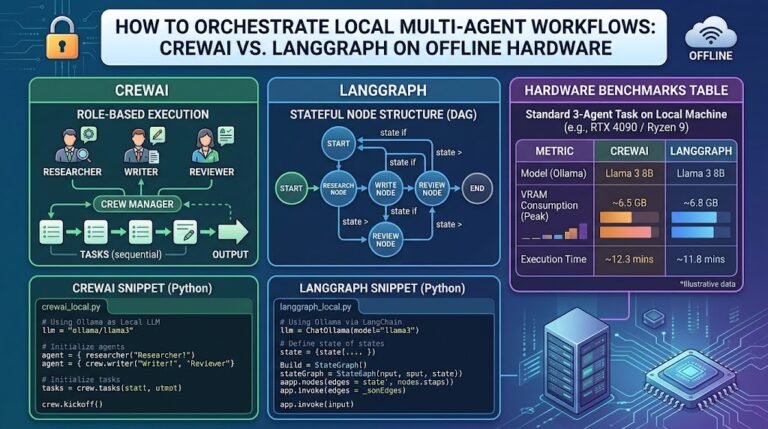
- State-Graph Architectures (LangGraph): Explicit cyclic graphs that treat agents as deterministic state machines.
- Role-Based Collaborations (CrewAI): High-level abstractions that model teams of specialized agents with shared goals.
- TypeScript-Native Execution Engines (Mastra): Full-stack, typed frameworks designed specifically for web and serverless runtimes.
                ┌───────────────────────────────────────┐
                │       What is your primary focus?     │
                └───────────────────┬───────────────────┘
                                    │
         ┌──────────────────────────┼──────────────────────────┐
         ▼                          ▼                          ▼
┌──────────────────┐       ┌──────────────────┐       ┌──────────────────┐
│ Enterprise State │       │ Rapid Role-Based │       │ TypeScript-First │
│   & Durability   │       │   Multi-Agent    │       │ Modern Web Stack │
└────────┬─────────┘       └────────┬─────────┘       └────────┬─────────┘
         │                          │                          │
         ▼                          ▼                          ▼
   [ LangGraph ]                [ CrewAI ]                 [ Mastra ]
Deep-Dive Architectural Breakdown
LangGraph: The Enterprise Standard for Deterministic Control
LangGraph remains the default choice for engineering teams building high-stakes, fault-tolerant AI applications where unpredictable state transitions cost real money.
from langgraph.graph import StateGraph, END
from typing import TypedDict, Annotated
import operator

class AgentState(TypedDict):
    messages: Annotated[list, operator.add]
    next_step: str

builder = StateGraph(AgentState)
builder.add_node("planner", run_planner)
builder.add_node("executor", run_executor)

builder.add_conditional_edges("planner", route_next, {"execute": "executor", "end": END})
builder.set_entry_point("planner")
graph = builder.compile()
Why Engineers Pick LangGraph
- Per-Node Checkpointing: Every node execution writes state to persistent storage. If a third-party API crashes mid-task, the workflow resumes from the exact node failure point rather than restarting.
interrupt()Human-in-the-Loop: Pauses state execution natively to wait for manual human approval before invoking sensitive write operations or processing payments.- Cyclic Graph Logic: Unlike traditional DAG (Directed Acyclic Graph) engines, LangGraph handles complex loops naturally—allowing agents to refine code or documents iteratively until explicit quality metrics are satisfied.
The Trade-Offs
- Verbose, boilerplate-heavy setup compared to higher-level abstractions.
- Steep initial learning curve for developers unused to writing state-machine logic.
CrewAI: The Velocity Champion for Role-Based Multi-Agent Teams
CrewAI prioritizes developer speed. It lets you model complex workflows using intuitive human metaphors: agents have defined roles, goals, tools, and backstories.
from crewai import Agent, Task, Crew, Process

researcher = Agent(
    role='Lead Security Researcher',
    goal='Identify vulnerabilities in the target repository',
    backstory='Senior SECOPS engineer specialized in dependency audits.',
    tools=[github_tool, CVE_database_tool]
)

audit_task = Task(
    description='Scan main branch for outdated packages and open CVEs.',
    expected_output='Markdown summary of severity levels.',
    agent=researcher
)

crew = Crew(
    agents=[researcher],
    tasks=[audit_task],
    process=Process.sequential
)

results = crew.kickoff()
Why Engineers Pick CrewAI
- Blazing Fast Prototyping: Takes hours—not days—to go from conceptual architecture to a functioning multi-agent demo.
- CrewAI Flows: Blends flexible, autonomous role-play with deterministic control structures for production routes.
- Extensible Ecosystem: Broad community adoption with ready-to-use tool integrations and agent templates.
The Trade-Offs
- Token Overhead: Autonomic multi-agent conversations pass heavy contextual history back and forth, burning through context windows and token budgets fast.
- Structural drift can occur if system prompts do not tightly enforce task execution constraints.
Mastra: The Production Workhorse for TypeScript Engineers
For years, Node and Next.js developers had to choose between clunky Python sub-processes or weak JS wrappers. Mastra solves this by providing a ground-up, end-to-end TypeScript framework.
import { Agent } from "@mastra/core/agent";
import { openai } from "@ai-sdk/openai";
import { z } from "zod";

export const triageAgent = new Agent({
  name: "System Triage Agent",
  instructions: "Analyze incoming system alerts and assign severity tags.",
  model: openai("gpt-4o"),
  tools: {
    checkDatadog: {
      description: "Fetch metric anomaly score",
      parameters: z.object({ service: z.string() }),
      execute: async ({ service }) => fetchMetrics(service),
    }
  }
});
Why Engineers Pick Mastra
- End-to-End Type Safety: Tools, inputs, outputs, and workflows use Zod schema definitions. Compiler errors catch model parameter mismatches before code hits staging.
- Built-in Production Primitives: Bundles Observational Memory, OpenTelemetry tracing, and evaluators (
evals) natively without requiring third-party SaaS sign-ups. - Native Model Context Protocol (MCP): Native capabilities to author and consume MCP servers out of the box, allowing simple integration into modern dev tools.
The Trade-Offs
- Newer ecosystem compared to Python heavyweights, meaning fewer community-contributed niche tools.
- Limited fit for AI teams whose entire ML deployment pipeline is tied strictly to Python ecosystems.
Technical Comparison Matrix
| Capability / Attribute | LangGraph | CrewAI | Mastra |
|---|---|---|---|
| Primary Language | Python (TypeScript port available) | Python | TypeScript (Native) |
| Orchestration Model | Graph-based state machine | Role-based Crews + Flows | Workflows + Autonomous Loop |
| State & Durability | Per-node persistent checkpointing | Memory Gateway / Flow State | Suspend/Resume Engine |
| Type Validation | Pydantic / TypedDict | Pydantic | Native Zod schemas |
| Observability | Native LangSmith Integration | CrewAI Studio / Tracing | OpenTelemetry + Built-in Evals |
| Best Target Use Case | Regulated, multi-step critical state systems | Rapid multi-agent prototypes & collaborative tasks | Enterprise web apps, Node services, Next.js stacks |
Actionable Selection Guide: 4 Steps to Decide
Follow this practical selection path before writing architectural spikes:
- Audit Your Main Stack Language
If your core application is written in Next.js, React, or Node.js, select Mastra. Forcing Python microservices into a pure JS web architecture adds unnecessary infra overhead. - Evaluate the Blast Radius of a Failure
Ask: “What happens if an agent crashes mid-task or emits malformed data?” If a crash breaks compliance or incurs financial liability, select LangGraph. Its node-level checkpointing gives you strict audit trails and instant recovery. - Assess Team Size and Delivery Timelines
If you need to show stakeholders an working multi-agent team demo within a week, select CrewAI. - Determine Human-in-the-Loop Requirements
If your application requires human review steps, inspect how each framework handles execution suspension. LangGraph and Mastra both provide clean suspend/resume primitives without holding memory sockets open.
Pro-Tip: The Infinite Loop & Token Bleed Trap
A frequent mistake in multi-agent orchestration is creating unbounded feedback loops.
When an agent tool returns an error, agents often try to self-correct by calling the same tool repeatedly with slight prompt tweaks. Without guardrails, a single failing database query can burn through millions of tokens in minutes.
# GOOD: Explicit recursion control in LangGraph state
def should_continue(state: AgentState):
    if state["retry_count"] >= 3:
        return "human_fallback_node" # Escalate gracefully
    if state["is_valid"]:
        return "success_node"
    return "retry_node"
Systems Admin Rule: Always enforce hard recursion limits (
max_stepsormax_retries) at the framework level, set global budget limits on model gateways, and route repeated failures directly to human review nodes.
Summary & Next Steps
- LangGraph: Pick it for complex, mission-critical Python workflows requiring explicit state control and deep auditing.
- CrewAI: Pick it when rapid development speed, role modeling, and multi-agent collaboration are your top priorities.
- Mastra: Pick it when building native web applications, API endpoints, or microservices inside the Node/TypeScript ecosystem.
To move forward, select two frameworks matching your primary stack, implement a single tool-calling feature with explicit error handling in both, and benchmark their latency, token consumption, and state persistence under simulated API failures.